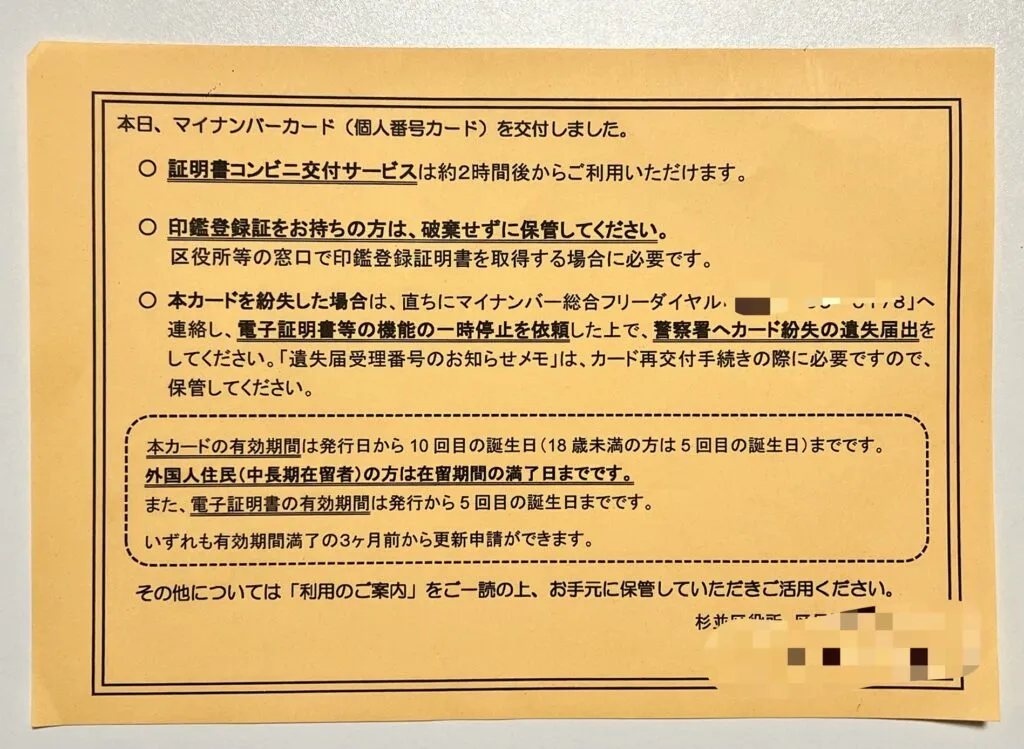
1. Overall Text Difficulty Level
N3 - N2 Level.
This text uses a large number of official written vocabulary (such as 「交付」, 「紛失」, 「有効期間」) and polite expressions (such as 「ご利用いただけます」). The sentence structures are clear but contain important conjunctive grammar, making it an excellent reading material for N2 preparation.
Original Sentence
本日、マイナンバーカード(個人番号カード)を交付しました。
English Translation: Today, we have issued your “Individual Number Card” (My Number Card).
Sentence Structure Breakdown
-
Core of the sentence: (私たちが)カードを交付しました。 (We issued the card.)
-
Modification relationships:
-
本日 (Today) → Limits the time of 「交付しました」.
-
マイナンバーカード(個人番号カード) (Individual Number Card) → The object of 「交付しました」.
-
-
Key grammar point of this sentence: The past tense of the verb’s 「ます形」.
Word-by-Word Analysis
-
本日 (ほんじつ) This is a noun, formal and written equivalent of 「今日 (きょう)」. It is very common in news, business documents, or official notices, sounding more solemn.
-
マイナンバーカード This is a katakana word derived from the English “My Number Card.” It is the common nickname for Japan’s “Individual Number Card.”
-
(個人番号カード (こじんばんごうカード)) This is the official legal name for 「マイナンバーカード」, meaning “Individual Number Card.” The parentheses here serve as supplementary information.
-
を Particle, read as “o”. Here, it is used to clearly indicate the object involved in the action 「交付する」, which is the “card.”
-
交付しました (こうふしました) This is a verb. 「交付する (こうふする)」 is its basic form (dictionary form), belonging to the “サ変” verbs. It means “to issue, to deliver,” and is mostly used in official occasions when government agencies or companies issue documents or certificates to individuals.
交付する→交付します(ます form) →交付しました(past tense of ます form). Indicates that the action has been completed.
Expression & Cultural Notes
This sentence omits the subject. In Japanese, if the context is clear, the subject (especially “I” or “we”) is often omitted. The context here is a notice issued by the ward office (district government), so it is obvious that the subject is “the staff of the ward office.”
The “My Number Card” is an IC card with a 12-digit individual number issued to all residents (including foreigners) in Japan, similar to a national identity card, used for handling various administrative procedures, identity verification, etc.
Key Takeaway
The core of this sentence is to master high-frequency kanji words common in official documents, such as 「本日 (ほんじつ)」 and 「交付 (こうふ) する」. At the same time, understand the habit of omitting the subject in Japanese.
Original Sentence
証明書コンビニ交付サービスは約2時間後からご利用いただけます。
English Translation: The convenience store certificate issuance service will be available in about 2 hours.
Sentence Structure Breakdown
-
Core of the sentence: サービスはご利用いただけます。(The service is available to use.)
-
Modification relationships:
-
証明書コンビニ交付 (Certificate convenience store issuance) → Modifies 「サービス」, explaining what kind of service it is.
-
約2時間後から (From about 2 hours later) → Explains the starting time of 「ご利用いただけます」.
-
-
Key grammar point of this sentence: お/ご~いただけます (Polite potential form)
Word-by-Word Analysis
-
証明書 (しょうめいしょ) Noun, meaning “certificate, credential.” For example, 「住民票の写し (じゅうみんひょうのうつし)」 (copy of residence certificate), etc.
-
コンビニ交付 (こうふ) A compound noun consisting of 「コンビニ」 (convenience store) and 「交付」 (issuance), referring to the service of “receiving (certificates) at a convenience store.”
-
サービス Katakana word from the English “service,” meaning “service.”
-
は Particle, prompting that the topic of the entire sentence is the “convenience store certificate issuance service.”
-
約 (やく) Adverb, meaning “about, approximately.”
-
2時間後 (にじかんご) Noun, meaning “2 hours later.”
-
から Particle, indicating the starting point of time, “from…”
-
ご利用いただけます (ごりよういただけます) This is the most crucial grammar point of this sentence, a very polite honorific expression. Let’s break it down:
-
Core verb:
利用する (りようする)- to use. -
Honorific conversion:
ご + 利用 (りよう)- nominalizes the verb and adds the honorific prefix 「ご」. -
Core grammar:
いただく- It is the humble form ofもらう(to receive). -
Conjugation:
いただく→いただける(potential form, can receive) →いただけます(ます form). -
Overall meaning: 「ご利用いただけます」 literally means “we can receive your use,” which by extension means “you may (honorably) use,” and is a very polite way of saying 「利用できます」 or 「利用することができます」, expressing respect for the customer/user. This is standard honorific language used when the service industry or public agencies speak to the public.
-
Detailed Analysis of Key Grammar Point: お/ご~いただく
-
Structure: お/ご + Verb ます form minus ます + いただく
-
Meaning: Indicates that the speaker requests the other party to do something for them, or receives a favor from the other party. Here, its potential state 「お/ご~いただけます」 means “you can…”, which is the honorific form of 「~てもらうことができる」 or 「~してくれることができる」.
-
Simple example sentences:
-
明日、もう一度お電話いただけますか。 (Could you please call me again tomorrow?)
-
こちらの席でお待ちいただけます。 (You may wait at this seat here.)
-
Key Takeaway
For this sentence, the key is to master the usage of the honorific potential state 「お/ご~いただけます」, which is a high-frequency test point in N2 listening and reading. Understanding it equals mastering one of the core honorifics in service scenarios.
Original Sentence
○ 印鑑登録証をお持ちの方は、破棄せずに保管してください。 ○ 区役所等の窓口で印鑑登録証明書を取得する場合に必要です。
English Translation: ○ Customers who possess a registered seal certificate, please do not discard it and keep it safe. ○ It is required when obtaining a registered seal certificate at the counters of the ward office and other places.
Sentence Structure Breakdown
First Sentence:
-
Core of the sentence: (あなたは)保管してください。(Please keep it.)
-
Modification relationships:
-
印鑑登録証をお持ちの (Possessing a registered seal certificate) → Modifies 「方」 (person).
-
破棄せずに (Without discarding) → Modifies the action 「保管してください」 in a negative state, explaining how to keep it.
-
-
Key grammar point of this sentence: ~ずに、~てください
Second Sentence:
-
Core of the sentence: (それが)必要です。( (That thing) is necessary.)
-
Modification relationships:
-
区役所等の窓口で (At counters of the ward office, etc.) → Limits the place of 「取得する場合」.
-
印鑑登録証明書を (Registered seal certificate) → The object of 「取得する」.
-
取得する場合に (When obtaining) → Limits the condition/occasion of 「必要です」.
-
-
Key grammar point of this sentence: ~場合に
Word-by-Word Analysis
-
印鑑登録証 (いんかんとうろくしょう) Noun, refers to the “registered seal certificate”, a card proving that your personal seal has been officially registered with government agencies.
-
お持ちの方 (おもちのかた) This is a polite expression. The honorific form of 「持つ」 is 「お持ちになる」. Here, 「お持ちの」 is used to modify 「方(かた)」 (a polite way to refer to a “person”), meaning “person who possesses…”.
-
は Particle, marks the topic.
-
破棄せずに (はきせずに) This is a key grammar point.
-
Core verb:
破棄する (はきする)- to discard, destroy. -
Core grammar:
~ずにis the written form of~ないで, meaning “without doing…”. It is attached to the stem of a verb’s ない form. -
Conjugation: The negative of
するisしない, and droppingないleavesし. Butするhas a special conjugation, becomingせず. So it is破棄せず.にis an optional particle that is sometimes omitted. -
Meaning:
破棄せずに保管してくださいmeans破棄しないで保管してください(Please keep it without discarding it).
-
-
保管してください (ほかんしてください)
保管する (ほかんする)means “to keep, store”. 「~てください」 is a sentence pattern used to request someone to do something. -
区役所等 (くやくしょなど)
区役所 (くやくしょ)is the ward office. 「等 (など)」 means “etc.”, implying it also includes branch offices and other related institutions. -
の Particle, indicating affiliation, “the counters of the ward office”.
-
窓口 (まどぐち) Noun, referring to “counter, window”.
-
で Particle, indicating the place where an action occurs.
-
印鑑登録証明書 (いんかんとうろくしょうめいしょ) Noun, “registered seal certificate”. This is an official document that can only be obtained using the registered seal card.
-
を Particle, indicating the object of 「取得する」.
-
取得する場合 (しゅとくするばあい)
取得する (しゅとくする)means “to acquire, obtain”.-
Core grammar:
~場合 (ばあい), attached to a verb, adjective, or noun, meaning “in the case of…”. -
取得する場合simply means “when/in the case of obtaining”.
-
-
に Particle, pointing here to a specific point in time or occasion, used with 「場合」 to emphasize “at that time”.
-
必要です (ひつようです) な-adjective, meaning “necessary, required”.
Expression & Cultural Notes
In Japan, seals (印鑑/ハンコ) still hold legal validity in many formal occasions (such as signing contracts or opening bank accounts), and their importance is equivalent to a signature. Therefore, seal registration and certification are very important administrative procedures. This notice reminds people that even with the multifunctional My Number Card, the old registered seal certificate cannot simply be thrown away.
Key Takeaway
The core of this paragraph is to master the usage of the written negative form 「~ずに」 (equivalent to 「~ないで」), as well as 「~場合(は/に)」 which expresses hypothetical situations. Both of these are frequent occurrences in the N2 exam.
Original Sentence
○ 本カードを紛失した場合は、直ちにマイナンバー総合フリーダイヤル「0120-95-0178」へ連絡し、電子証明書等の機能の一時停止を依頼した上で、警察署へカード紛失の遺失届出をしてください。「遺失届受理番号のお知らせメモ」は、カード再交付手続きの際に必要ですので、保管してください。
English Translation: ○ If you lose this card, please immediately contact the My Number comprehensive toll-free number “0120-95-0178”, request a temporary suspension of functions such as the electronic certificate, and then submit a lost property report for the card at a police station. Please keep the “Notice Memo of the Lost Property Report Receipt Number”, as it is required when undergoing procedures for card reissuance.
Sentence Structure Breakdown
This is a long sentence, let’s split it into two parts.
First Part Core: (あなたは)連絡し、依頼した上で、届出をしてください。 (Please contact, upon requesting, submit a report.)
-
Modification relationships:
-
本カードを紛失した場合 (If you lose this card) → Precondition for the entire action.
-
直ちに (Immediately) → Modifies 「連絡し」.
-
マイナンバー総合フリーダイヤルへ (To the … toll-free number) → Direction of 「連絡し」.
-
電子証明書等の機能の一時停止を (Temporary suspension of functions like electronic certificate) → Object of 「依頼した」.
-
警察署へ (To the police station) → Direction of 「届出をしてください」.
-
カード紛失の遺失届出 (Lost property report of the card) → Specific content of 「してください」.
-
-
Key grammar point of this sentence: ~場合は、~た上で、~てください
Second Part Core: 「メモ」は、必要ですので、保管してください。 (The “memo” is necessary, so please keep it.)
-
Modification relationships:
-
遺失届受理番号のお知らせ (Notice of the lost property report receipt number) → Modifies 「メモ」.
-
カード再交付手続きの際に (When undergoing card reissuance procedures) → Limits the occasion for 「必要です」.
-
-
Key grammar point of this sentence: ~際に、~ので
Word-by-Word Analysis
-
本カード (ほんカード) 「本~」 is a prefix indicating “this…, the said…”, used to refer to the subject currently being discussed. Very formal written language. For example: 本日 (today), 本社 (this company).
-
紛失した場合 (ふんしつしたばあい)
紛失する (ふんしつする)means “to lose, misplace”.紛失したis its past tense.~た場合はmeans “in the event that … occurs”. -
直ちに (ただちに) Adverb, meaning “immediately, at once”, more formal and urgent than 「すぐ」.
-
フリーダイヤル Katakana from English “free dial”, meaning “toll-free service number”.
-
へ Particle, indicating direction.
-
連絡し (れんらくし) The stem form (中止形) of
連絡する (れんらくする). When connecting multiple verbs, you can use the~てform, or this more formal stem form (ます form minus ます).連絡してand連絡しmean the same here. -
電子証明書等 (でんししょうめいしょなど) Noun, “electronic certificates, etc.”
-
機能 (きのう) Noun, “function”.
-
一時停止 (いちじていし) Noun, “temporary suspension”.
-
依頼した上で (いらいしたうえで) This is a very important N2 grammar point.
-
Core verb:
依頼する (いらいする)- to request, entrust. -
Core grammar:
~た上で, attached after theた formof a verb. -
Meaning: Indicates “after doing A, then doing B”. It emphasizes that A is a prerequisite or preparatory step for B, possessing a strong sense of sequence. Compared to a simple
~てから,~た上でis more formal and stresses that the completion of the preceding action is crucial to the following action. -
Simple example sentence: よく考えた上で、お返事します。 (I will reply to you after carefully thinking it over.)
-
-
警察署 (けいさつしょ) Noun, “police station”.
-
遺失届出 (いしつとどけで) Noun, “lost property report”.
-
~をしてください
届出をするis a verb phrase. 「~をしてください」 is a form of~てください, where for “Noun + する” verbs,をis often placed in the middle. -
遺失届受理番号 (いしつとどけじゅりばんごう) Noun, “lost property report receipt number”.
-
お知らせメモ (おしらせメモ) Noun, “notice memo”.
-
再交付 (さいこうふ) Noun, “reissuance, replacing”.
-
手続き (てつづき) Noun, “procedure”.
-
の際に (のさいに)
際 (さい)is a noun meaning roughly the same as時 (とき), but more formal, often used in public notices and business contexts.~の際に/~際にmeans “at the time of…”. -
ので Conjunctive particle, indicating cause or reason. Because the preceding fact objectively exists, it leads to the following result.
Key Takeaway
This long sentence is typical official instructional text. The core is understanding the sequence of actions and logical relationships. You must master the strong sequential sense of 「~た上で」 meaning “do A then do B”, and 「~際に」 used to mean “at the time of” in formal contexts.
Original Sentence
本カードの有効期間は発行日から10回目の誕生日(18歳未満の方は5回目の誕生日)までです。 外国人住民(中長期在留者)の方は在留期間の満了日までです。 また、電子証明書の有効期間は発行日から5回目の誕生日までです。 いずれも有効期間満了の3ヶ月前から更新申請ができます。
English Translation: The validity period of this card is from the date of issuance until your 10th birthday (for those under 18, the 5th birthday) from that date. For foreign residents (mid- to long-term residents), the validity is until the expiration date of the period of stay. Furthermore, the validity period of the electronic certificate is until the 5th birthday from the date of issuance. For all of these, renewal applications can be made starting 3 months prior to the expiration of the validity period.
Sentence Structure Breakdown
This is a compound paragraph made of four independent sentences, with clear logic.
-
First sentence core: 有効期間は~誕生日までです。(The validity period is up to the … birthday.)
-
Second sentence core: (有効期間は)満了日までです。( (The validity period) is up to the expiration date.)
-
Third sentence core: 有効期間は~誕生日までです。(The validity period is up to the … birthday.)
-
Fourth sentence core: (あなたは)更新申請ができます。(You can apply for renewal.)
-
Modification relationships (Fourth sentence):
-
いずれも (All of these) → Refers to all the validity periods mentioned earlier.
-
有効期間満了の3ヶ月前から (From 3 months prior to the expiration of the validity period) → Limits the starting time for 「できます」.
-
Word-by-Word Analysis
-
有効期間 (ゆうこうきかん) Noun, “validity period”.
-
発行日 (はっこうび) Noun, “date of issuance, date of issue”.
-
~回目 (~かいめ) Suffix, indicating “the …th time”.
10回目means “the 10th time”. -
誕生日 (たんじょうび) Noun, “birthday”.
-
未満 (みまん) Noun, attached after a number to mean “under…, less than…”.
18歳未満refers to people under the age of 18. -
まで Particle, indicating an endpoint, “until, up to…”.
-
外国人住民 (がいこくじんじゅうみん) Noun, “foreign residents”.
-
中長期在留者 (ちゅうちょうきざいりゅうしゃ) Noun, “mid- to long-term residents”, referring to foreigners holding a valid long-term visa in Japan.
-
在留期間 (ざいりゅうきかん) Noun, “period of stay”, referring to the permitted duration of stay in Japan allowed by a visa.
-
満了日 (まんりょうび) Noun, “date of expiration, expiry date”.
-
また Conjunction, indicating “furthermore, in addition”, used to add information.
-
いずれも Adverb, meaning “every one (of two or more), all of them”, here referring to all the validity periods mentioned above.
-
満了 (まんりょう) Noun or サ変 verb, “expiration”.
-
~ヶ月前 (~かげつまえ) ”… months ago/prior”.
3ヶ月前is “3 months prior”. -
更新申請 (こうしんしんせい) Noun, “renewal application”.
-
できます The ます form of the verb
できる, meaning “can, be able to”, which is the potential form.
Key Takeaway
This paragraph primarily provides informational notice, so the grammar is relatively simple. The focus is on accumulating vocabulary related to administrative procedures, such as 「有効期間」, 「発行日」, 「満了日」, 「更新申請」, etc. Also, pay attention to the usage of 「未満」 and 「いずれも」.
Original Sentence
その他については、「利用のご案内」をご一読の上、お手元に保管していただきご活用ください。
English Translation: Regarding other matters, please read the “Usage Guide” and keep it at hand for your reference and utilization.
Sentence Structure Breakdown
-
Core of the sentence: (あなたは)保管していただきご活用ください。(Please keep and utilize.)
-
Modification relationships:
-
その他については (Regarding other matters) → Limits the scope of discussion for this sentence.
-
「利用のご案内」を (“Usage Guide”) → Object of 「ご一読の上」.
-
ご一読の上 (Upon reading once) → Explains the action before 「保管していただき」.
-
お手元に (At hand) → Explains the location for 「保管して」.
-
-
Key grammar point of this sentence: ~については、~の上、~ていただく、ご~ください
Word-by-Word Analysis
-
その他 (そのほか/そのた) Noun, meaning “others, addition”.
-
については Compound particle, consisting of
に+ついて+は, used to bring up a topic for explanation, “regarding…”. -
「利用のご案内」 (りようのごあんない) Proper noun, “Usage Guide”.
-
ご一読の上 (ごいちどくのうえ) This is another very formal written expression.
-
一読 (いちどく)- to read through once. -
ご一読- adds the honorific prefixご. -
Core grammar:
~の上 (で). When attached to “Noun + の” or theた formof a verb, it means something similar to~た上で, meaning “after having done…”.ご一読の上=一読した上で.
-
-
お手元に (おてもとに)
手元 (てもと)refers to “at hand, nearby”. Adding the honorific prefixおshows respect to the other party.お手元に保管するmeans “keep at your hand”. -
保管していただき (ほかんしていただき)
保管する→保管して(て form).~ていただくis the humble form of~てもらう, expressing a request for the other party to do something for oneself with a sense of gratitude.保管していただきis more polite and euphemistic than保管してください, conveying the nuance of “I would appreciate it if you could kindly keep it”. -
ご活用ください (ごかつようください) This is the honorific form of requesting the other party to do something.
-
Core verb:
活用する (かつようする)- to utilize, to make good use of. -
Core grammar:
お/ご + Verb ます form minus ます + ください. This is a more respectful way of requesting than~てください. -
ご活用ください= the honorific form of活用してください.
-
Key Takeaway
This sentence is a great compilation of honorific expressions. You need to memorize three core honorific patterns:
-
~の上 (うえ): Written language, meaning “after…”.
-
~ていただく: Humble language, meaning “Please do… (for me)”.
-
お/ご~ください: Honorific language, meaning “Please do…”. Proficient use of these will greatly elevate the formality of your Japanese.
Final Summary
Vocabulary List
| Word | Reading | English Meaning |
|---|---|---|
| 本日 | ほんじつ | Today (formal expression) |
| 交付 | こうふ | Issuance, delivery |
| 証明書 | しょうめいしょ | Certificate |
| 破棄 | はき | Discard, destroy |
| 保管 | ほかん | Keep, storage |
| 印鑑登録証 | いんかんとうろくしょう | Registered seal certificate |
| 取得 | しゅとく | Acquisition, obtainment |
| 窓口 | まどぐち | Counter, window |
| 必要 | ひつよう | Necessary, requirement |
| 紛失 | ふんしつ | Loss, misplacement |
| 直ちに | ただちに | Immediately, at once |
| 連絡 | れんらく | Contact |
| 電子証明書 | でんししょうめいしょ | Electronic certificate |
| 機能 | きのう | Function |
| 一時停止 | いちじていし | Temporary suspension |
| 依頼 | いらい | Request, entrust |
| 警察署 | けいさつしょ | Police station |
| 遺失届出 | いしつとどけで | Lost property report |
| 再交付 | さいこうふ | Reissuance, replacing |
| 手続き | てつづき | Procedure |
| 有効期間 | ゆうこうきかん | Validity period |
| 発行日 | はっこうび | Date of issuance |
| 未満 | みまん | Under, less than |
| 在留期間 | ざいりゅうきかん | Period of stay |
| 満了日 | まんりょうび | Date of expiration |
| いずれも | いずれも | All, any of them |
| 更新申請 | こうしんしんせい | Renewal application |
| 一読 | いちどく | Read through once |
| 活用 | かつよう | Utilize, make good use of |
| 総合 | そうごう | Comprehensive |
Grammar Checklist
| Grammar Point | Structure | Function and Explanation |
|---|---|---|
| お/ご~いただけます | お/ご + Vます (minus ます) + いただけます | A very polite way of saying “you can (do something)”, the potential state of a humble honorific verb, more respectful than 「~できます」. |
| ~ずに | Vない (minus ない) + ずに | ”Without doing…”, the written form of 「~ないで」, used to connect two actions. |
| ~場合 (ばあい) | V/A/N + 場合 | ”In the case of…”, used for hypothetical situations. |
| ~た上で (~たうえで) | Vた + 上で | ”After doing…”, emphasizes the previous action as a prerequisite or preparation for the following action, strongly sequential, more formal than 「~てから」. |
| ~際に (~さいに) | V/Nの + 際に | ”At the time of…”, the formal expression of 「~とき」, commonly seen in written language and formal contexts. |
| ~の上 (~のうえ) | Vた/Nの + 上 | ”After…”, similar in meaning to 「~た上で」, also a formal written expression. |
| ~ていただく | Vて + いただく | ”Please do… (for me)”, the humble form of 「~てもらう」, expressing a request with gratitude. |
| お/ご~ください | お/ご + Vます (minus ます) + ください | ”Please do…”, the honorific form of 「~てください」, highly polite. |
~ていただく is the humble form of ~てもらう,
what does it exactly mean? Sometimes it is “the user receives”, sometimes it is “sorry to bother you to keep it”.
Let’s break down the grammar point 「~ていただく」 thoroughly.
Core: It is ALWAYS “Our side receives a favor”
First, please firmly remember a core concept: Whether it is 「~てもらう」 or its humble form 「~ていただく」, the subject of the sentence (often omitted) is always the receiver of the action. The core perspective of the entire sentence is “I (or my side) received the favor of someone doing something for me”.
-
もらう: To receive (from a peer/junior).
-
いただく: To receive/accept (from an elder/superior/client). This lowers oneself and elevates the other party.
Therefore, the literal meaning of 「~ていただく」 is “I (humbly) accept the favor of (you) doing… for me”.
Why are there two translations that look different?
“Sometimes it’s the user receives, sometimes it’s sorry to trouble you”, is actually this core meaning applied in two different sentence patterns. They are essentially the same thing.
Let’s look at the two situations:
Situation 1: As a declarative sentence (I received…)
When 「~ていただく」 is used at the end of a sentence as a complete statement, it expresses gratitude and a fact.
Example 1: 先生に日本語を教えていただきました。
-
Literal translation: I (humbly) received the favor of the teacher teaching me Japanese.
-
Natural translation: The teacher taught me Japanese. (This sentence contains deep gratitude)
Here, it is what you understood as “the user receives”. I received the benefit brought by the action “the teacher teaches me”.
Example 2: 部長に書類を確認していただきました。
-
Literal translation: I (humbly) received the favor of the department manager confirming the document for me.
-
Natural translation: The department manager confirmed the document for me. (Similarly, full of gratitude)
Situation 2: As a request/instruction sentence (Please do… for me)
This is the part that confused you. When 「~ていただく」 is used in the context of a request or instruction, it becomes an extremely euphemistic and polite way to make a request.
Imagine that saying directly 「保管してください」 (Please keep) is a command or direct request.
Then how about saying 「保管していただく」?
保管していただき、ご活用ください。 (The usage in the original text)
The 「保管していただき」 in this sentence is actually a mid-sentence pause, and its underlying logic is: “We wish to (humbly) accept the favor of you keeping it for us, and then please utilize it.”
See, the core meaning hasn’t changed! The speaker (ward office) places themselves in a very low position, packaging an action that should have been an “instruction” into an expression of “we request to accept your favor”.
-
Direct request: Please store it. (保管してください)
-
Request using 「~ていただく」: We would be grateful if you would do us the favor of storing it. (保管していただく)
This creates the nuance of “sorry to bother you” or “please trouble yourself”. Because it is not commanding you, but rather asking you to bestow the favor of “keeping” it.
Let’s look at a more common request pattern:
「~ていただけますか。」 (Could you please do… for me?)
Example: この漢字の読み方を教えていただけますか。
-
Literal translation: Could I (humbly) receive the favor of you teaching me the reading of this Kanji?
-
Natural translation: Could you teach me how to read this Kanji? / Sorry to bother you to teach me…
This is a very polite way of asking. You are not asking if the other party “has the ability to teach”, but asking “Do I have the honor of receiving your teaching?”.
Summary and Comparison
| Expression | Nuance | Core Logic |
|---|---|---|
| ~てください | Direct Request/Instruction | You do it. (Focus is on the other party’s action) |
| ~てくれますか | Ordinary Request | Can you do it for me? (Focus is on the other party’s willingness) |
| ~ていただけますか | Very Polite Request | May I have the honor of receiving the favor of you doing… for me? (Focus is on whether my side can “receive the favor”, very euphemistic) |
| ~ていただきました | Declaring a fact + Gratitude | I have already had the honor of receiving the favor of… (Focus is on the favor already received by my side and the feeling of gratitude) |
So, you see the translation “Sorry to trouble you to keep it” precisely because the speaker, by using 「~ていただく」, lowers themselves and entirely hands over the decision-making power and favor of the “keeping” action to the listener (the user), thereby creating an extremely polite atmosphere of “I am causing you trouble, but I still leave it in your hands.”
Remember: The perspective is always “our side receives a favor”.
-
Already received → Gratitude.
-
Want to receive → Extremely polite request.