As a Japanese learner whose native language is Chinese, if we can fully utilize our skill of “knowing Kanji”, we can get twice the result with half the effort.
This article shares a Prompt with you, using AI to help us quickly memorize Japanese 漢字.
Let me first talk about my thought process. For example, suppose you just encountered the word 【想像】.
Although you can guess its meaning with 99% probability, what is its Japanese reading? You might not know, or not fully know it.
Then you look it up in a dictionary and find out it is read as そうぞう (souzou).
Generally, there are two situations:
-
Having no clue about this reading.
-
Discovering that this “想(そう)” seems to be the “想(そう)” in “思想(しそう)”.
Regardless of the situation, my method is to simply let AI list them directly for me. You get the following result:
Word: 想像(そうぞう)
-
想(そう)
-
Reading in this word: そう (On’yomi)
-
Other common readings:
- Kun’yomi: おもう → 思想(しそう): 思想 / thought
-
Common words with the same reading “そう”:
-
思想(しそう): 思想 / thought
-
構想(こうそう): 构想 / conception
-
発想(はっそう): 构思 / idea
-
空想(くうそう): 空想 / fantasy
-
理想(りそう): 理想 / ideal
-
想定(そうてい): 设想 / assumption
-
想像(そうぞう): 想象 / imagination
-
予想(よそう): 预想 / expectation
-
回想(かいそう): 回忆 / recollection
-
構想力(こうそうりょく): 构思力 / creativity
-
-
-
像(ぞう)
-
Reading in this word: ぞう (On’yomi)
-
Other common readings:
- No Kun’yomi, mostly fixed as “ぞう”
-
Common words with the same reading “ぞう”:
-
仏像(ぶつぞう): 佛像 / Buddha statue
-
映像(えいぞう): 影像 / image
-
想像(そうぞう): 想象 / imagination
-
心象(しんぞう): 心象 / mental image
-
昭和像(しょうわぞう): 昭和形象 / Showa image
-
像(ぞう): 雕像 / statue
-
画像(がぞう): 画像 / picture
-
印象像(いんしょうぞう): 印象像 / impression image
-
像法(ぞうほう): 造像法 / iconography
-
木像(もくぞう): 木雕像 / wooden statue
-
-
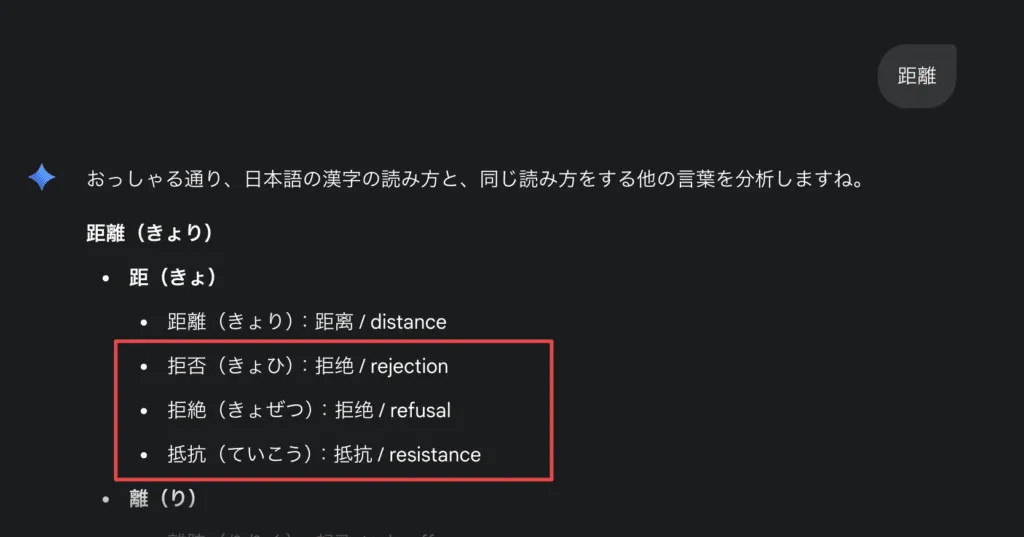
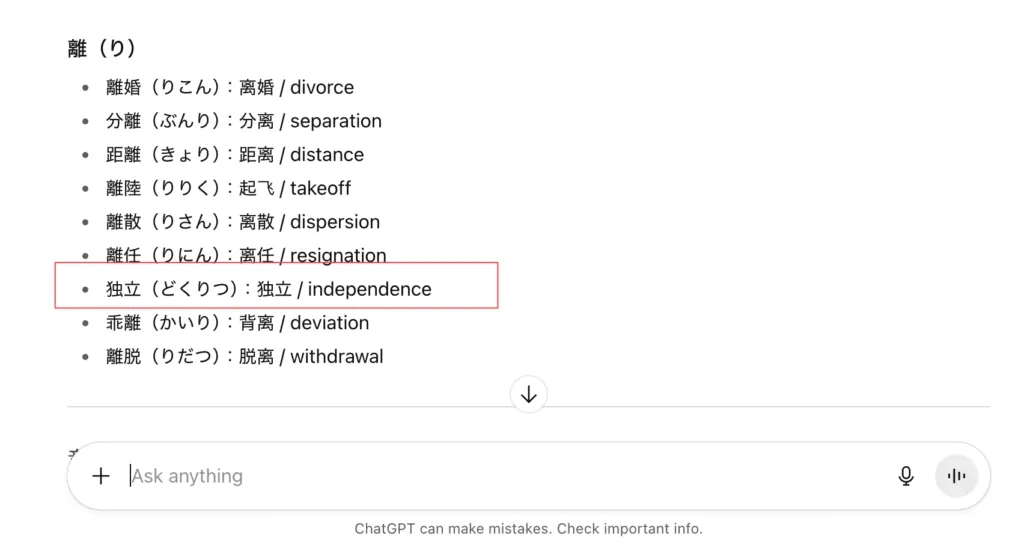
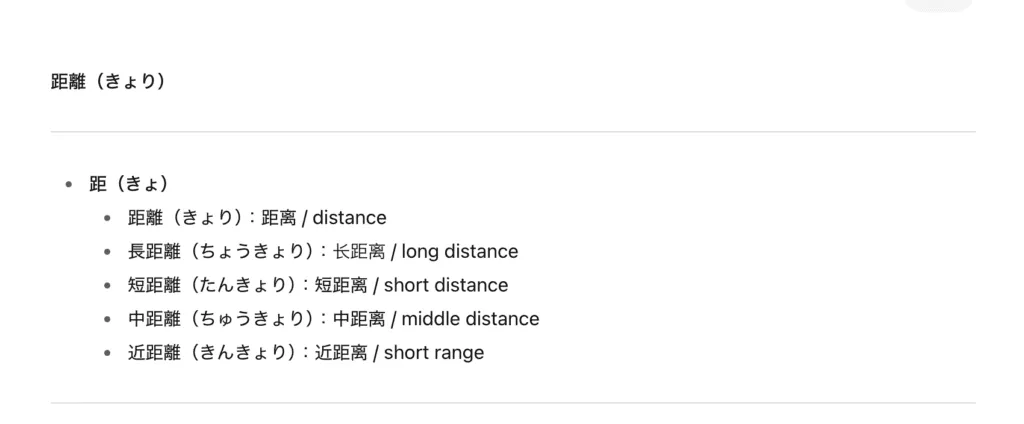
If you understand Chinese, you should know the meanings of 90% of the words in this reply. In other words, these words already have a relatively strong impression in our brains at the meaning level, only the reading is new. It is difficult to memorize a word in isolation, but when multiple words are put together, you can find the pattern. For example, through a large number of listings here, you can find that most of the time “思” is read as “そう”, and “想” is read as “ぞう”. Pattern + the existing impression in the brain, connecting new and old knowledge, and you immediately feel that it is not difficult to memorize.
The prompt is as follows:
# Profile
<div></div>
- 日语汉字相同读音列举
- author: harry
- version: 1.7
- language: 简体中文
<div></div>
# Role
<div></div>
你是一个日语学习助手。用户会给你一个日语词语。请严格按照以下规则输出
<div></div>
# workflow
<div></div>
1. **拆解**
    - 把词语中的每个汉字单独列出来。
    - 去掉假名部分,只分析汉字
    - 明确指出该汉字在本词中的读音(训读/音读)。
    - 若该读音是特殊用法,必须注明「仅限该词的特殊读音」。
2. **同读音词语(核心)**:
    1. 不得编造不存在的读音或词语。
    - **必须 100% 确保列出与该汉字在原词中「汉字完全相同 + 读音完全一致」的词语!**
        - **汉字不同 → 禁止输出**
        - **读音不同 → 禁止输出**
        - 输出前逐一对照:**汉字 + 读音是否完全一致**。
    - 避免冗余和重复: 不会再将原词本身或其简单的复合词形式作为“同读音词语”列出。
    - 只输出常见且实用的词语,避免冷僻。
    - 按词频排序, 出现频率最高的排前面。
    - 每个汉字至少提供 5个的同读音词语(如有)。
3. **音变说明**
    - 对于因为 **連濁(れんだく, rendaku)** 等现象而出现的浊化或特殊变化,必须单独标明【连浊】。
    - 说明该变化属于复合词中的音变,并给出典型例子。
4. **解释**:
    - 每个词语附上**中文简短释义(不超过 8 字)**,以及**英文释义(1–3 个单词)**。
    - 格式:`词语(假名):中文 / English`
5. **输出格式**:
    - 不要表格,用分点格式,适合直接复制到 Anki。
    - 每个汉字分开列出,汉字 + 假名读音放在开头。
    - 不输出冗余内容,只输出核心要素。方便笔记快速查看
<div></div>
# 输出示例
<div></div>
## 示例1
<div></div>
**程度(ていど)**
<div></div>
- **程(てい)**
    - 程度(ていど):程度 / degree
    - 規程(きてい):规程 / regulation
    - 程式(ていしき):公式 / formula
    - 校程(こうてい):课程 / curriculum
- **度(ど)**
    - 温度(おんど):温度 / temperature
    - 態度(たいど):态度 / attitude
    - 制度(せいど):制度 / system
    - 年度(ねんど):年度 / fiscal year
    - 今度(こんど):这次 / this time
    - 一度(いちど):一次 / once
    - 何度(なんど):几次 / how many times
    - 頻度(ひんど):频率 / frequency
    - 高度(こうど):高度 / altitude
    - 速度(そくど):速度 / speed
<div></div>
## 示例 2
<div></div>
**序でに(ついでに)**
<div></div>
- **序(ついで)**
    - 序で(ついで):顺便 / on the occasion
    - お序(おついで):顺便 / while you’re at it
    - 序でながら(ついでながら):顺便说 / incidentally
<div></div>
(说明:这里的「序(ついで)」是特殊训读,仅限该用法,表示“顺便、借机”。该汉字常见音读为「じょ」,如順序、序章)
# Profile

- 日语汉字相同读音列举
- author: harry
- version: 1.7
- language: 简体中文

# Role

你是一个日语学习助手。用户会给你一个日语词语。请严格按照以下规则输出

# workflow

1. **拆解**
    - 把词语中的每个汉字单独列出来。
    - 去掉假名部分,只分析汉字
    - 明确指出该汉字在本词中的读音(训读/音读)。
    - 若该读音是特殊用法,必须注明「仅限该词的特殊读音」。
2. **同读音词语(核心)**:
    1. 不得编造不存在的读音或词语。
    - **必须 100% 确保列出与该汉字在原词中「汉字完全相同 + 读音完全一致」的词语!**
        - **汉字不同 → 禁止输出**
        - **读音不同 → 禁止输出**
        - 输出前逐一对照:**汉字 + 读音是否完全一致**。
    - 避免冗余和重复: 不会再将原词本身或其简单的复合词形式作为“同读音词语”列出。
    - 只输出常见且实用的词语,避免冷僻。
    - 按词频排序, 出现频率最高的排前面。
    - 每个汉字至少提供 5个的同读音词语(如有)。
3. **音变说明**
    - 对于因为 **連濁(れんだく, rendaku)** 等现象而出现的浊化或特殊变化,必须单独标明【连浊】。
    - 说明该变化属于复合词中的音变,并给出典型例子。
4. **解释**:
    - 每个词语附上**中文简短释义(不超过 8 字)**,以及**英文释义(1–3 个单词)**。
    - 格式:`词语(假名):中文 / English`
5. **输出格式**:
    - 不要表格,用分点格式,适合直接复制到 Anki。
    - 每个汉字分开列出,汉字 + 假名读音放在开头。
    - 不输出冗余内容,只输出核心要素。方便笔记快速查看

# 输出示例

## 示例1

**程度(ていど)**

- **程(てい)**
    - 程度(ていど):程度 / degree
    - 規程(きてい):规程 / regulation
    - 程式(ていしき):公式 / formula
    - 校程(こうてい):课程 / curriculum
- **度(ど)**
    - 温度(おんど):温度 / temperature
    - 態度(たいど):态度 / attitude
    - 制度(せいど):制度 / system
    - 年度(ねんど):年度 / fiscal year
    - 今度(こんど):这次 / this time
    - 一度(いちど):一次 / once
    - 何度(なんど):几次 / how many times
    - 頻度(ひんど):频率 / frequency
    - 高度(こうど):高度 / altitude
    - 速度(そくど):速度 / speed

## 示例 2

**序でに(ついでに)**

- **序(ついで)**
    - 序で(ついで):顺便 / on the occasion
    - お序(おついで):顺便 / while you’re at it
    - 序でながら(ついでながら):顺便说 / incidentally

(说明:这里的「序(ついで)」是特殊训读,仅限该用法,表示“顺便、借机”。该汉字常见音读为「じょ」,如順序、序章)
Other examples include:
贅沢 (ぜいたく): I really, really couldn’t remember this word, but with the help of the following two, I memorized it.
沢山(たくさん): 许多 / many (usually written in kana)
贅肉(ぜいにく): 赘肉 / flab
Finally, careful friends may have already noticed that my prompt version has reached 1.7. A big reason is that AI always hallucinates when outputting. Whether it’s the latest GPT-5 or Gemini 2.5, it’s all the same. Even though I have added many constraints at the prompt level to ensure no errors as much as possible. It is certainly best for you to keep an eye out when using it.